
A Complete Solubillix Guide to CPT 98016, Provider Eligibility, AMA & CMS Guidance, and Billing Success
By Solubillix – Medical Billing Solutions Built for Modern Healthcare
Healthcare communication has changed dramatically in recent years. Patients no longer depend solely on office visits to receive guidance from their healthcare providers. Short virtual discussions now play an important role in delivering timely care, improving patient satisfaction, and helping practices operate more efficiently.
As communication-based healthcare services continue to grow, accurate billing becomes increasingly important. One code attracting provider attention is CPT 98016.
Many practices still struggle to understand when this code applies, who may bill it, and how to stay compliant with payer requirements. Billing errors can result in claim denials, delayed reimbursement, and unnecessary administrative work.
This Solubillix guide breaks down everything providers need to know about CPT 98016 billing, including provider eligibility, documentation expectations, and key guidance from AMA and CMS.
What Is CPT 98016?
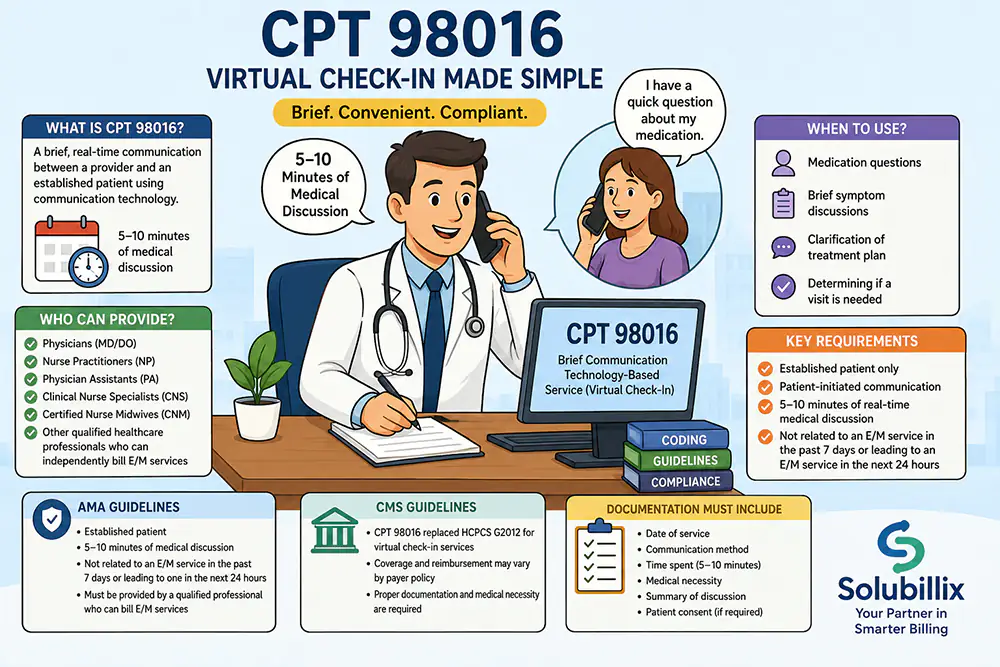
CPT 98016 describes a brief virtual communication service between an established patient and a qualified healthcare provider.
Unlike a traditional office appointment or full telehealth evaluation, this service involves a short real-time clinical discussion designed to address limited medical concerns.
The purpose of CPT 98016 is straightforward—allow providers to offer professional medical guidance when a complete visit is unnecessary.
These interactions may involve:
- Medication concerns
- Mild symptom discussions
- Clarification of care instructions
- Follow-up guidance
- Determining whether a larger visit is needed
- Addressing limited clinical questions requiring medical judgment
For many practices, CPT 98016 supports more efficient patient communication while helping reduce avoidable office visits.
Why CPT 98016 Matters in Today’s Healthcare Environment
Modern healthcare depends on accessibility and timely communication.
Patients often seek answers quickly, while providers need compliant ways to deliver guidance without disrupting scheduling or creating unnecessary appointments.
When used correctly, CPT 98016 can support both clinical care and financial performance.
Benefits may include:
- Improved patient convenience
- Reduced scheduling burden
- Better continuity of care
- Faster clinical communication
- Cleaner reimbursement opportunities
- Reduced avoidable claim denials
- More efficient revenue cycle operations
Practices that understand communication-based billing often position themselves more effectively in today’s healthcare landscape.
Who Can Provide CPT 98016 Services?
One of the most important billing questions involves provider eligibility.
Not every staff member may report CPT 98016.
This service is generally intended for physicians and qualified healthcare professionals who are authorized to independently report Evaluation and Management (E/M) services.
Common eligible providers may include:
- Physicians (MD/DO)
- Nurse Practitioners (NP)
- Physician Assistants (PA)
- Clinical Nurse Specialists (CNS)
- Certified Nurse Midwives (CNM)
- Other qualified providers allowed to independently bill E/M services under payer and state rules
Because CPT 98016 involves medical decision-making and professional clinical communication, it is typically not billed by clinical support staff or medical assistants.
Provider eligibility should always be reviewed against payer policy and applicable regulations.
Which Specialties Commonly Use CPT 98016?
CPT 98016 may benefit numerous medical specialties.
Common examples include:
Primary Care
Brief symptom discussions, medication clarification, and follow-up communication.
Internal Medicine
Managing chronic conditions and reviewing limited clinical concerns.
Behavioral Health
Supporting established patients through brief communication when a full session is not required.
Cardiology
Medication-related questions and care coordination discussions.
Endocrinology
Diabetes and hormone-management communication.
Specialty Practices
Virtual patient guidance that helps determine whether additional care is necessary.
As virtual communication becomes more integrated into care delivery, specialty practices increasingly explore appropriate use of communication-based services.
When Should CPT 98016 Be Reported?
Correct timing is essential for compliant billing.
CPT 98016 is generally intended for brief patient communication that can be resolved without a comprehensive visit.
Examples may include:
- Questions about prescribed treatment
- Mild symptom updates
- Medication side-effect concerns
- Clarification of provider instructions
- Determining next care steps
- Limited follow-up discussion
The service should involve professional medical assessment rather than purely administrative communication.
Appointment scheduling, insurance discussions, or non-clinical conversations typically do not support medical billing.
Understanding AMA Guidance for CPT 98016
The American Medical Association (AMA) establishes CPT coding definitions and reporting guidance.
AMA guidance emphasizes several important concepts related to CPT 98016.
Established Patient Requirement
CPT 98016 is intended for established patients.
This means the provider already has an existing professional relationship with the patient.
New patient communication generally follows different billing pathways.
Time Requirement
The service involves a brief medical discussion, commonly understood as a short real-time interaction.
Time documentation remains an important part of compliant reporting.
Independent Clinical Service
AMA guidance also emphasizes that communication-based services should stand independently rather than functioning as bundled follow-up care.
Practices should carefully evaluate encounter circumstances before submitting claims.
Understanding AMA coding expectations helps reduce reporting errors and strengthen claim accuracy.
CMS and Medicare Considerations for CPT 98016
Coding and reimbursement are not always identical.
While AMA defines CPT codes, CMS determines Medicare reimbursement policies and coverage guidance.
Providers should understand that Medicare and commercial payers may apply separate billing rules.
CMS places significant emphasis on:
- Medical necessity
- Proper documentation
- Provider involvement
- Clear communication records
- Compliance with payer policy
Practices should also recognize that payer interpretation can differ.
A code that meets CPT definition still requires proper documentation and policy compliance to support payment.
Because Medicare communication-service policies continue evolving, routine payer verification remains essential.
Documentation Tips That Help Prevent Denials
Documentation is often the difference between payment and rejection.
Strong records support both reimbursement and audit readiness.
For CPT 98016, providers should consider documenting:
Communication Method
Telephone or approved communication platform.
Date and Time
Clear record of service timing.
Clinical Concern
Reason for patient communication.
Medical Discussion
Provider assessment and professional guidance delivered.
Medical Necessity
Why professional involvement was required.
Patient Consent
When required by payer policy.
Incomplete records frequently lead to denials and rework.
Consistent documentation workflows help protect reimbursement.
Common CPT 98016 Billing Mistakes
Even experienced practices encounter billing issues with communication-based services.
Frequent mistakes include:
- Incomplete documentation
- Missing time details
- Incorrect patient eligibility
- Confusion between telehealth and communication services
- Billing services linked to broader evaluation visits
- Failure to review payer requirements
These issues may delay reimbursement and increase administrative burden.
Preventing denials begins with proper education and billing oversight.
How Solubillix Supports Providers with Complex Billing
Communication-based services create new opportunities—but they also introduce coding and reimbursement challenges.
At Solubillix, we help healthcare providers strengthen revenue cycle performance through:
- Medical billing support
- Denial management
- Telehealth and specialty billing assistance
- AR follow-up
- Claims review
- Compliance-focused billing workflows
- Revenue optimization strategies
Our approach combines billing accuracy with practical revenue solutions designed to support modern healthcare practices.
Final Thoughts
Healthcare is moving toward faster, more connected patient communication—and billing processes must evolve alongside it.
CPT 98016 represents more than a billing code. It reflects a broader shift toward accessible, communication-driven care.
Understanding who can provide the service, when it applies, and how AMA and CMS guidance influence billing helps providers reduce risk and improve reimbursement outcomes.
With accurate documentation and knowledgeable billing support, practices can use communication-based services more confidently and efficiently.
Solubillix remains committed to helping providers simplify billing, reduce denials, and build stronger financial performance through dependable medical billing expertise.