
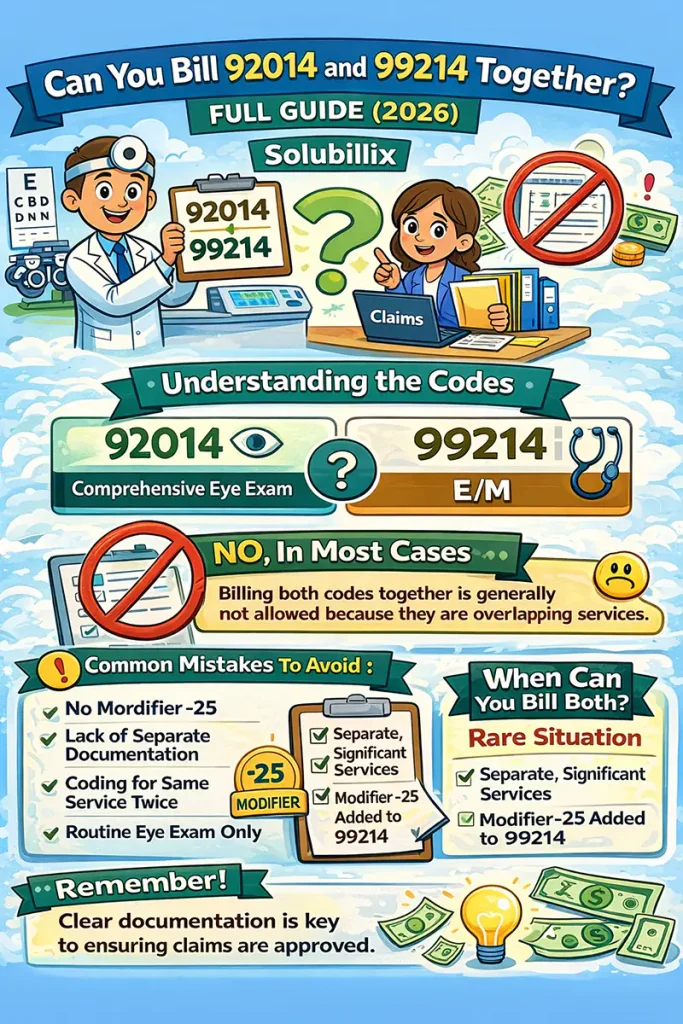
One of the most common questions in ophthalmology billing is whether providers can bill 92014 (comprehensive eye exam) and 99214 (established patient E/M visit) on the same day.
Incorrect billing of these codes can lead to denials, audits, or even compliance risks. At Solubillix, we help practices navigate these complexities and ensure accurate, compliant billing.
This 2026 guide explains when you can bill these codes together—and when you should avoid it.
Understanding the Codes
What is 92014?
92014 is an ophthalmological service code used for a comprehensive eye exam for an established patient. It typically includes:
- Detailed eye examination
- Evaluation of visual function
- Medical observation and assessment
- Initiation or continuation of diagnostic/treatment plan
👉 This code is specific to eye care services and does not rely on standard E/M guidelines.
What is 99214?
99214 is an Evaluation and Management (E/M) code for an established patient visit involving:
- Moderate level medical decision-making
- Evaluation of patient’s condition
- Management of treatment plan
👉 This code is used for medically necessary visits beyond routine eye exams.
Can You Bill 92014 and 99214 Together?
🚫 In Most Cases: NO
Generally, you should not bill both codes together for the same patient on the same day because:
- Both codes represent overlapping services
- Payers consider this duplicate billing
- One service is usually considered inclusive of the other
👉 Most insurance companies will deny one of the codes automatically.
✅ When Can You Bill Them Together?
There are rare situations where billing both codes may be appropriate—but strict criteria must be met.
✔ Scenario: Separate, Significant Services
You may bill both if:
- A comprehensive eye exam (92014) is performed
- AND a separately identifiable medical evaluation (99214) is provided
- The services are distinct and medically necessary
✔ Modifier Requirement
If both are billed together, you must use:
- Modifier -25 on the E/M code (99214)
👉 This indicates that the E/M service is separate and significant from the eye exam.
📋 Documentation Requirements
To support billing both codes, documentation must clearly show:
- Two distinct services performed
- Separate medical necessity for each
- Detailed notes supporting E/M decision-making
- No duplication of exam elements
👉 Without strong documentation, the claim is likely to be denied.
⚠️ Common Billing Mistakes
Avoid these frequent errors:
- Billing both codes without modifier -25
- Lack of documentation supporting separate services
- Using both codes for routine exams
- Copy-paste documentation (audit risk)
- Not verifying payer-specific rules
At Solubillix, we often see these mistakes leading to unnecessary revenue loss.
🧠 Best Practice: Choose the Right Code
In most cases, it’s better to choose one code based on the visit type:
Use 92014 when:
- The visit is primarily an eye exam
- Focus is on visual system evaluation
Use 99214 when:
- The visit is medically focused
- Requires moderate decision-making
- Involves management of systemic or complex conditions
📊 Real-World Example
A patient comes in for a routine comprehensive eye exam but also reports new symptoms like severe eye pain.
✔ If the provider performs:
- Full eye exam → 92014
- AND evaluates new medical condition separately → 99214 + modifier -25
👉 Then both codes may be billed (if documentation supports it).
💰 Impact on Reimbursement
Incorrect use of these codes can result in:
- Claim denials
- Payment delays
- Compliance audits
- Revenue loss
Correct coding ensures:
- Faster payments
- Reduced denials
- Improved cash flow
Why Choose Solubillix?
At Solubillix, we specialize in ophthalmology billing and coding accuracy. Our services include:
- Claim submission and denial management
- Coding audits and compliance checks
- Revenue cycle optimization
- Staff training and support
We help practices get paid faster while staying fully compliant.
Conclusion
Billing 92014 and 99214 together is possible—but only in rare, well-documented cases. In most situations, providers should choose the code that best reflects the primary service performed.
Understanding these guidelines helps reduce denials and ensures accurate reimbursement.
Partner with Solubillix to simplify your ophthalmology billing and maximize revenue.