

Optical Coherence Tomography (OCT) has become one of the most essential diagnostic tools in modern optometry and ophthalmology. From detecting glaucoma to monitoring retinal diseases, OCT technology allows providers to capture detailed cross-sectional images of ocular structures and support early diagnosis of serious eye conditions.
While OCT testing significantly improves patient care, billing for these services can often create confusion for optometry practices. Improper coding, missing documentation, or incorrect insurance verification can easily result in claim denials or delayed reimbursements.
Understanding the correct approach to OCT billing is critical for maintaining an efficient revenue cycle and ensuring accurate reimbursement. At Solubillix, we help optometry practices simplify complex billing processes, reduce denials, and optimize revenue through expert eye-care billing services.
What Is Optical Coherence Tomography (OCT)?
Optical Coherence Tomography is a non-invasive imaging test used to capture high-resolution cross-sectional images of the retina and optic nerve. The technology allows eye care providers to examine retinal layers in detail and identify early signs of disease that may not be visible during a routine eye exam.
OCT plays a vital role in diagnosing and monitoring many eye conditions, including:
- Glaucoma
- Macular degeneration
- Diabetic retinopathy
- Retinal edema
- Macular holes
- Retinal detachment
Because OCT provides advanced diagnostic insight, it is commonly billed as a medical diagnostic test when medically necessary.
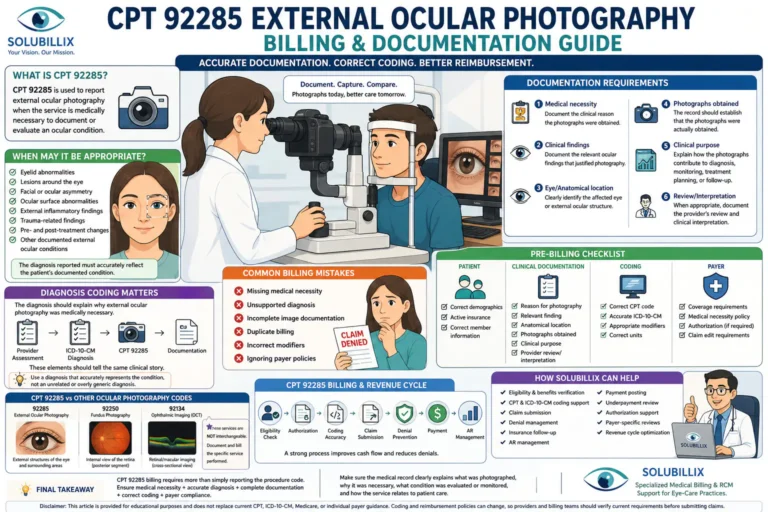
OCT CPT Code Used in Optometry
The primary CPT code used for Optical Coherence Tomography is:
CPT 92133 – Scanning computerized ophthalmic diagnostic imaging of optic nerve
This code is typically used when evaluating the optic nerve, especially for glaucoma diagnosis and monitoring.
Another commonly used code is:
CPT 92134 – Scanning computerized ophthalmic diagnostic imaging of retina
This code applies when OCT imaging focuses on the retina to diagnose or monitor retinal conditions such as macular degeneration or diabetic retinopathy.
Correctly selecting the appropriate CPT code is essential for claim approval and proper reimbursement.
When OCT Is Considered Medically Necessary
Insurance carriers generally reimburse OCT testing when it is performed to diagnose or monitor a medical eye condition. To qualify as medically necessary, the test must support clinical evaluation of a documented diagnosis or suspected disease.
Common diagnoses supporting OCT billing include:
- Glaucoma or suspected glaucoma
- Age-related macular degeneration
- Diabetic macular edema
- Retinal disorders
- Optic nerve abnormalities
If the OCT test is performed solely as part of a routine vision exam without a medical indication, it may not be covered by medical insurance.
Proper documentation is therefore critical for successful claim processing.
Documentation Requirements for OCT Billing
Accurate documentation plays a major role in claim approval for OCT procedures. Insurance payers typically require detailed medical records demonstrating the necessity of the diagnostic imaging.
Documentation should include:
- Patient symptoms or clinical findings
- Medical diagnosis supporting the test
- Physician interpretation and report
- Image documentation stored in the patient record
- Comparison with prior imaging when applicable
The physician must also provide a clear interpretation of the imaging results rather than simply storing the image in the patient file.
Strong documentation helps protect practices from audits and ensures compliance with payer requirements.
Common OCT Billing Mistakes in Optometry
Many optometry practices experience reimbursement challenges due to common billing errors. Avoiding these mistakes can significantly improve claim approval rates.
Incorrect CPT Code Selection
Using CPT 92133 instead of 92134, or vice versa, can lead to claim denials. Providers must select the code based on the specific anatomical structure being evaluated.
Lack of Medical Necessity
Performing OCT without a documented medical condition may cause insurers to deny the claim.
Missing Interpretation and Report
Simply capturing the OCT image is not sufficient. The physician must provide a formal interpretation of the imaging results.
Duplicate Testing Without Justification
Frequent OCT testing without clear clinical justification may trigger payer audits or claim denials.
OCT Billing and Insurance Verification
Before performing OCT imaging, practices should verify the patient’s insurance benefits to determine whether the procedure is covered under medical insurance.
Eligibility verification helps identify:
- Coverage policies for OCT imaging
- Patient deductible or copay requirements
- Frequency limitations for diagnostic imaging
- Prior authorization requirements
Proper insurance verification helps prevent claim rejections and unexpected patient billing issues.
The Role of Modifiers in OCT Billing
In some cases, modifiers may be required to properly report OCT services. For example, modifiers may be used when procedures are performed on both eyes or when multiple diagnostic services are completed during the same visit.
Correct use of modifiers ensures accurate reporting and prevents claim processing errors.
Because modifier rules vary among payers, practices must carefully review insurance guidelines before submitting claims.
How Efficient OCT Billing Improves Practice Revenue
OCT imaging represents an important revenue opportunity for optometry practices. However, improper billing processes can lead to underpayment, claim denials, or administrative delays.
Optimizing OCT billing allows practices to:
- Improve claim approval rates
- Reduce billing errors
- Increase diagnostic service reimbursement
- Strengthen revenue cycle performance
When billing processes are streamlined, providers can focus more on patient care rather than administrative challenges.
Why Optometry Practices Choose Solubillix for Eye Care Billing
Eye care billing requires specialized knowledge of ophthalmology and optometry coding guidelines. Managing diagnostic imaging services such as OCT, along with complex insurance rules, can quickly become overwhelming for busy practices.
Solubillix provides dedicated optometry and ophthalmology billing solutions designed to simplify revenue cycle management and improve reimbursement outcomes.
Our experienced billing specialists help practices with:
- Accurate CPT and ICD-10 coding
- Insurance eligibility verification
- Claim submission and tracking
- Denial management and appeals
- Compliance monitoring and reporting
By partnering with Solubillix, eye care providers gain access to expert billing support that ensures OCT services and other procedures are billed accurately and efficiently.
Final Thoughts
Optical Coherence Tomography has become a cornerstone of modern eye care, providing critical insights for diagnosing and monitoring serious ocular conditions. However, proper billing practices are essential to ensure practices receive appropriate reimbursement for these diagnostic services.
By understanding OCT CPT codes, maintaining strong documentation, and verifying medical necessity, optometry practices can reduce claim denials and improve financial performance.
For practices seeking to streamline their billing processes and maximize reimbursements, Solubillix delivers specialized optometry and ophthalmology billing services designed to support the success of modern eye care providers.