
In today’s complex healthcare environment, running a profitable medical practice is about more than seeing patients — it’s about monitoring the right metrics. Key Performance Indicators (KPIs) in medical billing give practice owners visibility into revenue flow, claim accuracy, and operational efficiency.
At Solubillix, we help providers in New York and beyond track, analyze, and optimize the most critical billing KPIs to improve cash flow, reduce denials, and strengthen financial stability.
Why KPIs Matter in Medical Billing
Medical billing KPIs are measurable values that indicate how efficiently your practice is converting services into revenue. Tracking KPIs allows you to:
- Identify revenue leakage before it becomes a problem
- Reduce claim denials and delays
- Improve cash flow and accounts receivable (AR) days
- Maintain compliance with payers and regulatory standards
- Make informed business decisions backed by data
Without KPI tracking, practices risk blind spots that lead to lost revenue and operational inefficiency.
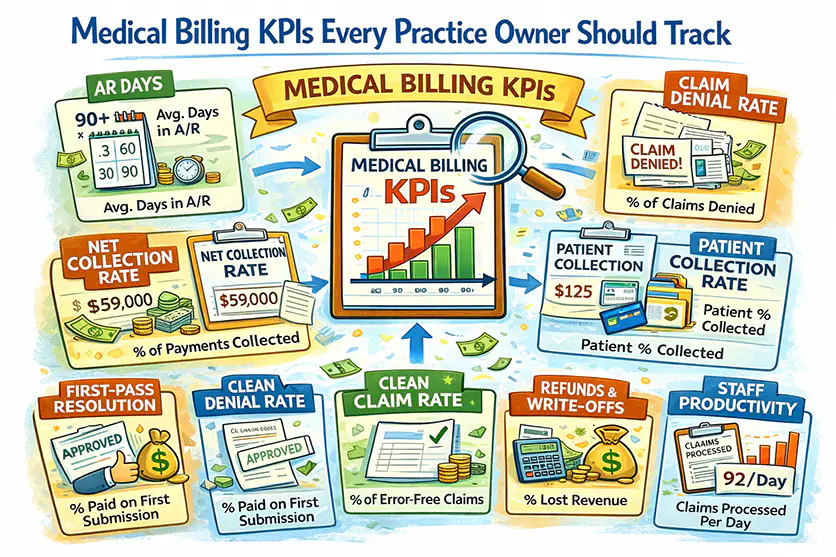
Top Medical Billing KPIs Every Practice Owner Should Track
1. Days in Accounts Receivable (AR Days)
Definition: The average number of days it takes for a claim to be paid from the date of service.
Why It Matters: High AR days indicate delayed payments and cash flow problems. Monitoring this KPI helps you identify bottlenecks in claim submission, follow-up, or patient collections.
2. Claim Denial Rate
Definition: The percentage of claims denied by payers.
Why It Matters: Frequent denials are a major source of revenue loss. By tracking denial rates, you can:
- Identify recurring errors (coding, documentation, authorization)
- Implement proactive strategies to prevent future denials
- Optimize revenue cycle efficiency
3. First-Pass Resolution Rate
Definition: The percentage of claims paid on the first submission without corrections or resubmissions.
Why It Matters: A low first-pass resolution rate signals inefficiencies in documentation, coding, or payer compliance. Improving this KPI reduces administrative costs and AR aging.
4. Clean Claim Rate
Definition: The percentage of claims submitted without errors.
Why It Matters: Errors on claims (wrong codes, mismatched modifiers, incomplete documentation) are a primary cause of denials. Tracking clean claim rate helps maximize reimbursement and reduce delays.
5. Patient Collection Rate
Definition: The percentage of patient-responsible balances collected successfully.
Why It Matters: Rising patient responsibility means practices must actively track copays, coinsurance, and deductibles. Efficient patient collections directly improve cash flow and reduce outstanding AR.
6. Net Collection Rate
Definition: Total payments collected (from insurance and patients) divided by total charges billed, expressed as a percentage.
Why It Matters: This KPI measures overall billing efficiency. A low net collection rate may indicate high denial rates, underpayments, or inefficient patient collections.
7. Aging of Accounts Receivable by Payer
Definition: Breakdown of AR by payer and age (30, 60, 90+ days).
Why It Matters: This KPI highlights which payers are causing delays and allows practices to prioritize follow-ups and optimize cash flow.
8. Refunds and Write-offs
Definition: Total value of claims adjustments, refunds, or write-offs due to denials or errors.
Why It Matters: High write-offs signal billing inefficiencies and revenue leakage. Monitoring this KPI helps implement corrective actions and prevent recurring losses.
9. Authorization & Eligibility Compliance Rate
Definition: Percentage of services with proper prior authorization and verified patient eligibility.
Why It Matters: Non-compliance leads to denials and delayed payments. Keeping this KPI high ensures claims are accepted on first submission.
10. Staff Productivity & Billing Efficiency
Definition: Number of claims processed per billing staff per week or month.
Why It Matters: Tracking productivity ensures your billing team is efficient and that administrative processes are optimized.
How Solubillix Helps You Track & Optimize Billing KPIs
Tracking KPIs is only effective if paired with expert analysis and actionable insights. At Solubillix, we help practices:
- Implement real-time KPI dashboards tailored to your practice
- Identify trends in claim denials and AR aging
- Optimize patient collections and payer follow-up workflows
- Reduce administrative burden and maximize revenue
- Stay compliant with payer rules and regulatory standards
The Bottom Line
KPIs are the backbone of financial visibility and control in medical billing. Practices that actively monitor the right metrics:
- Improve revenue and cash flow
- Reduce claim denials and AR days
- Prevent compliance and audit issues
- Make data-driven strategic decisions
Solubillix empowers practice owners with KPI tracking and billing insights, ensuring that your practice is not only financially healthy but also audit-ready and efficient.
Medical billing today is about intelligence, strategy, and insight — not just coding. Tracking KPIs is the first step toward smarter revenue management.