
Medical Billing, Coding & Revenue Cycle Management for Healthcare Providers
Speech-language pathology billing is approaching one of its most significant coding changes in years.
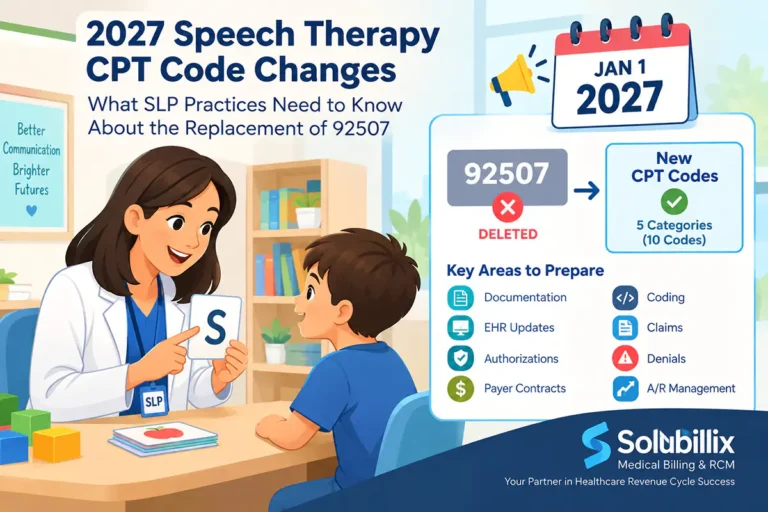
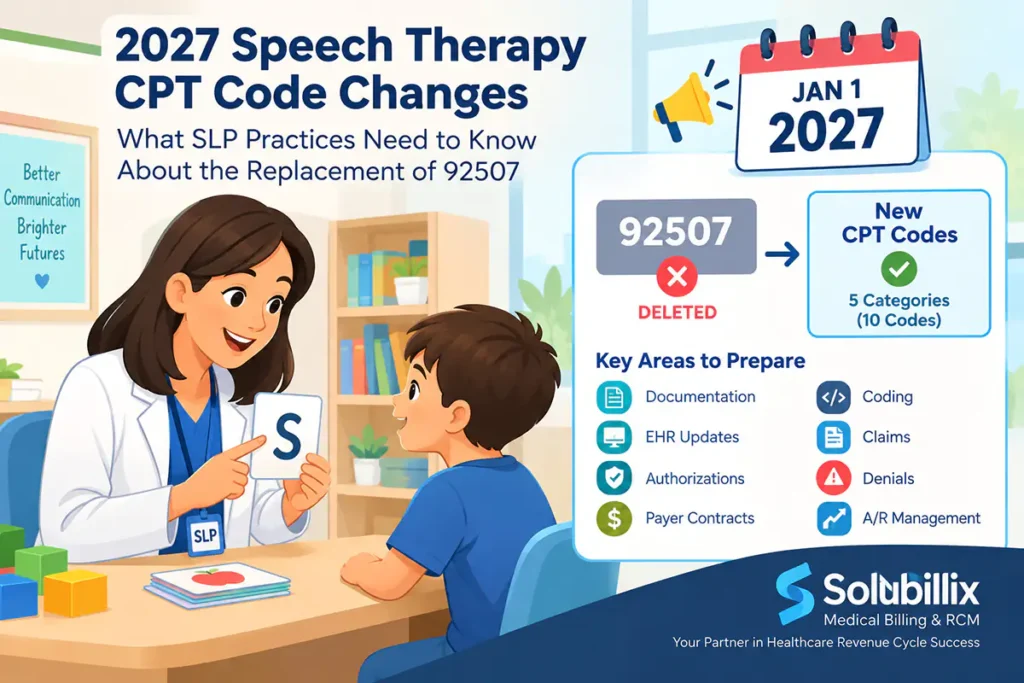
Beginning January 1, 2027, CPT code 92507 will be deleted and replaced by a new family of speech-language pathology treatment codes. Instead of using one broad code for most individual speech, language, voice, communication, and auditory-processing treatment, the new structure separates services into specific clinical categories and introduces a time-based reporting model.
For SLP practices, this is more than a simple code-number update.
The change can affect documentation, time tracking, EHR configuration, charge capture, claim submission, payer contracts, authorizations, reimbursement, and denial management.
At Solubillix, we recommend that speech therapy practices begin preparing their billing and documentation workflows before the 2027 effective date.
Important 2027 update: The new code numbers currently published by ASHA are placeholders pending publication of the official 2027 CPT code set. Practices should verify the final code numbers and payer implementation requirements before submitting 2027 claims.
What Is Happening to CPT 92507 in 2027?
CPT 92507 has historically been used for individual treatment involving speech, language, voice, communication, and/or auditory processing disorders.
That changes on January 1, 2027.
CPT 92507 remains applicable through December 31, 2026. Beginning January 1, 2027, it is scheduled to be deleted and replaced by 10 new individual-treatment codes organized into five clinical categories.
The new structure is designed to provide greater specificity about:
- The clinical condition being treated
- The type of treatment performed
- Direct patient-contact time
- The complexity and nature of the service
This represents a major shift from the broad, generally untimed 92507 model to a more specific time-based treatment structure.
Why Is CPT 92507 Being Replaced?
According to ASHA, the change followed a review of CPT 92507 after CMS and the AMA identified substantial growth in Medicare utilization of the code.
The review was conducted through the AMA CPT and RUC processes, with ASHA working with practicing clinicians and subject-matter experts on the new code structure.
The new structure is intended to provide:
- More specific reporting of clinical services
- Recognition of differences in treatment time
- Better representation of patient needs and service complexity
- More detailed information for payers
- Coding that better reflects contemporary SLP practice
For providers, the practical takeaway is simple:
The days of treating 92507 as a single catch-all individual treatment code are coming to an end.
What Will Replace CPT 92507?
The replacement structure contains five clinical treatment categories, with two codes assigned to each category:
- A base code for the initial 30 minutes
- An add-on code for each additional 15 minutes
ASHA currently identifies the following categories and placeholder codes. Final official code numbers should be confirmed when the 2027 CPT code set is published.
| Clinical service | Current placeholder base code | Current placeholder add-on |
| Fluency disorders | 92654 | +92655 |
| Speech sound production disorders | 92656 | +92657 |
| Language comprehension and expression disorders | 92658 | +92659 |
| Combined speech sound production and language disorders | 92660 | +92661 |
| Voice, upper airway dysfunction and/or resonance disorders | 92662 | +92663 |
Important: These numbers are currently identified by ASHA as placeholders until the official 2027 CPT code set is released. Do not treat the placeholder numbers as final for billing purposes without verifying the published 2027 code set and payer requirements.
The Biggest Change: 92507 Becomes Time-Based
One of the most important changes for SLP practices is the move toward direct, one-on-one treatment time.
Each new clinical category has:
- A base code covering the initial 30 minutes
- An add-on code for each additional 15 minutes
For example, the language-treatment category currently uses placeholder codes 92658 and 92659.
Under the proposed structure:
- The base code represents the initial 30 minutes.
- The add-on code represents each additional 15 minutes.
ASHA explains that under the general CPT midpoint convention, the base service may generally be reported after 16 minutes, while the first additional 15-minute unit may generally be reported after the initial 30 minutes plus at least 8 additional minutes. However, payer-specific requirements and final CPT/CMS instructions must be verified.
Example: 55-Minute Language Treatment Session
Suppose an SLP provides 55 minutes of direct, one-on-one language treatment.
Under the current published framework, the reporting would be:
92658 × 1
92659 × 2
The first 30 minutes are represented by the base code, followed by two additional 15-minute increments under the midpoint convention described by ASHA.
This makes accurate time documentation substantially more important than it was under the traditional 92507 workflow.
What Happens to CPT 92508?
Not every speech therapy treatment code is being replaced.
CPT 92508 will remain available for group treatment involving two or more individuals, although its description and instructions are being revised.
ASHA currently describes 92508 as an untimed group treatment code.
Therefore, SLP billing teams should not assume that every existing speech therapy CPT code is being eliminated.
Why Documentation Will Matter More in 2027
The new structure creates a stronger connection between:
Clinical service → diagnosis/condition → treatment provided → direct treatment time → CPT code
That means documentation templates may need to change.
SLPs should consider whether their notes clearly identify:
- The disorder or condition treated
- The specific treatment performed
- Treatment goals addressed
- Direct patient-contact time
- Start and stop times when required
- Progress toward established goals
- Medical necessity
- Any separate services performed during the encounter
ASHA specifically recommends that practices update documentation templates so the clinical service and direct treatment time are clearly recorded.
How the Change Could Affect SLP Billing
The 2027 transition can affect several parts of the revenue cycle.
1. EHR and Practice Management Systems
Your EHR may currently have:
- 92507 built into charge templates
- 92507 linked to specific diagnoses
- 92507 configured with payer fee schedules
- 92507 included in superbills
- 92507 connected to authorization workflows
Those configurations will need to be reviewed before January 2027.
2. Documentation Templates
A documentation template designed around an untimed 92507 workflow may not capture all of the information needed for the new time-based structure.
SLPs should work with their clinical and billing teams to make sure treatment time is documented consistently.
3. Authorization Workflows
Prior authorizations frequently identify specific CPT codes.
When 92507 is replaced, practices should review existing authorizations and determine how each payer will handle the transition.
Do not assume that an authorization containing 92507 will automatically transfer to the new codes.
4. Fee Schedules and Contracts
Commercial insurers, Medicare Advantage plans, Medicaid programs, and other payers may implement the new codes differently.
ASHA specifically advises practices to contact payers regarding adoption, coverage, authorization, billing, payment policies, contracts, and fee schedules.
5. Claim Denials
A code transition creates several potential denial points.
For example:
- Deleted CPT code submitted after the effective date
- New code not loaded into the payer system
- Incorrect base/add-on code combination
- Insufficient documented treatment time
- Authorization still tied to 92507
- Incorrect diagnosis-to-service relationship
- Incorrect fee schedule
- EHR transmitting an outdated code
- Payer-specific billing rules not followed
A proactive review can prevent many of these problems before claims reach the payer.
What SLP Practices Should Do Before January 1, 2027
Step 1: Identify Your 92507 Volume
Start by determining how often your practice currently bills 92507.
Review:
- Claims
- Charge reports
- EHR data
- CPT utilization
- Payer mix
- Reimbursement by payer
- Denial reports
This will tell you how significant the transition will be for your practice.
Step 2: Review Your Documentation
Look at your current speech therapy notes.
Ask:
Can our documentation clearly demonstrate the treatment category and direct treatment time?
If the answer is no, update the workflow before the new codes become effective.
Step 3: Prepare Your EHR
Work with your EHR or practice-management vendor to determine:
- When the new codes will be available
- How charge templates will be updated
- How old 92507 charges will be handled
- How fee schedules will be loaded
- Whether authorization workflows will change
- Whether claim edits will need to be updated
Step 4: Contact Major Payers
Don’t rely solely on your EHR vendor.
Ask each major payer:
- When will the new codes be loaded?
- Will 92507 be accepted after January 1, 2027?
- Will existing authorizations need to be updated?
- What are the new reimbursement rates?
- Are new prior authorizations required?
- Are there payer-specific unit limitations?
- Are there special modifier requirements?
ASHA notes that payer implementation may vary among Medicare Advantage, Medicaid, commercial insurers, and other health plans.
Step 5: Train Your Team
Your clinicians, billers, coders, front-office staff, and authorization team should understand the change.
Training should cover:
Clinical staff
- Selecting the appropriate treatment category
- Documenting treatment time
Coders
- Selecting the correct base and add-on codes
- Reviewing documentation
Billers
- Claim submission
- Payer-specific requirements
- Denial follow-up
Authorization staff
- Updating authorizations
- Confirming payer implementation
Practice managers
- Reviewing reimbursement and financial impact
Will 92507 Still Be Used in 2026?
Yes.
The transition date is January 1, 2027.
According to ASHA, CPT 92507 remains in effect through December 31, 2026. Practices should not report the new replacement codes before their effective date.
That creates an important distinction:
Dates of service through December 31, 2026 → follow the applicable 2026 CPT rules.
Dates of service beginning January 1, 2027 → follow the finalized 2027 CPT code set and payer-specific requirements.
What About Medicare, Medicaid and Commercial Insurance?
This is one of the areas where SLP practices need to be especially careful.
The CPT change establishes the new code structure, but payer implementation can vary.
Medicare, Medicare Advantage, Medicaid, and commercial insurers may have different:
- Coverage policies
- Fee schedules
- Authorization requirements
- Claim-processing rules
- Modifier requirements
- Effective dates
- Documentation requirements
ASHA recommends that SLP practices verify payer-specific implementation rather than assuming every insurer will process the new codes identically.
For practices with a large Medicaid or commercial payer mix, this should be part of the 2026 preparation plan.
Will This Change SLP Reimbursement?
It may.
However, practices should not assume that the new coding structure automatically means higher or lower reimbursement.
Medicare valuation and payment information has been going through the 2027 rulemaking process, and final Medicare values will be established through the CY 2027 Medicare Physician Fee Schedule final rule.
Commercial and Medicaid reimbursement will also depend on individual payer policies and contracts.
For this reason, SLP practice owners should evaluate their own historical 92507 utilization and payer contracts rather than relying on a generalized reimbursement estimate.
A Practical 92507 Transition Checklist
Before January 1, 2027, SLP practices should confirm:
☐ 92507 utilization has been reviewed
☐ New 2027 CPT information has been reviewed
☐ Final CPT code numbers have been verified
☐ EHR templates have been updated
☐ Charge master has been updated
☐ Fee schedules have been reviewed
☐ Documentation templates capture treatment time
☐ Clinical staff have received training
☐ Coding staff have received training
☐ Billing staff have received training
☐ Existing authorizations have been reviewed
☐ Major payers have been contacted
☐ Payer-specific requirements have been documented
☐ Claim edits have been tested
☐ Denial-management workflows have been updated
☐ First-quarter 2027 claims will be monitored closely
How Solubillix Can Help SLP Practices Prepare
A CPT code transition affects more than the billing department.
It can affect the entire revenue cycle—from documentation and charge capture to authorization, claim submission, payment posting, and denial management.
Solubillix supports physical, occupational, and speech therapy practices with specialized medical billing and revenue cycle services, including CPT/ICD-10 coding, authorization and eligibility workflows, claims submission, denial management, credentialing, payer enrollment, and therapy billing support.
For an SLP practice preparing for the 2027 transition, our team can help review:
- Current 92507 utilization
- Payer mix and reimbursement
- Documentation workflows
- Charge capture
- EHR configuration
- Authorization processes
- Fee schedules
- Claim submission workflows
- Denial trends
- A/R impact
The objective isn’t simply to replace one CPT code with another.
The goal is to make sure your entire billing workflow is ready for the change.
Frequently Asked Questions
Is CPT 92507 being deleted in 2027?
Yes. CPT 92507 is scheduled for deletion effective January 1, 2027 and will be replaced by 10 individual-treatment codes organized into five clinical categories.
Can SLPs still bill 92507 in 2026?
Yes. ASHA states that 92507 remains in effect through December 31, 2026.
What will replace CPT 92507?
The replacement structure consists of five pairs of codes covering fluency, speech sound production, language comprehension/expression, combined speech and language, and voice/upper airway/resonance treatment.
Will the new speech therapy codes be timed?
Yes. The new individual-treatment structure uses a base code for the initial 30 minutes and an add-on code for each additional 15 minutes.
Is CPT 92508 being deleted?
No. CPT 92508 remains available for group treatment involving two or more individuals, with revised instructions.
Are the new 2027 CPT code numbers final?
At the time of this article’s publication, the code numbers presented by ASHA are identified as placeholders pending publication of the official 2027 CPT code set. Practices should verify the final code set before billing.
Will every insurance company implement the change the same way?
Not necessarily. Payer implementation can vary, so SLP practices should verify coverage, authorization, billing, documentation, payment, and effective-date requirements with each payer.
Final Takeaway for SLP Practice Owners
The replacement of CPT 92507 is one of the most important speech therapy billing changes scheduled for 2027.
The biggest operational shift is the move away from a broad individual-treatment code toward a more specific, time-based coding structure.
SLP practices should use the remainder of 2026 to review their:
Documentation → Coding → EHR → Authorizations → Fee Schedules → Payer Contracts → Claims → Denials → A/R
Waiting until the first 2027 claim is denied is not the ideal time to discover that an EHR template, authorization, payer contract, or billing workflow was never updated.
At Solubillix, we help therapy practices navigate complex billing, coding, payer, and revenue-cycle requirements so providers can spend more time delivering patient care and less time resolving billing problems.
Need help preparing your SLP practice for the 2027 CPT transition? Contact Solubillix for a review of your speech therapy billing workflow.
This article is provided for educational and revenue-cycle planning purposes. CPT codes, descriptors, Medicare payment policies, and payer requirements may change. Always verify the final 2027 CPT code set and applicable payer policies before submitting claims.
About Solubillix:
Solubillix is a medical billing, coding, credentialing, and revenue cycle management company serving healthcare providers. Our specialty services include physical, occupational, and speech therapy practice billing and revenue cycle support.