
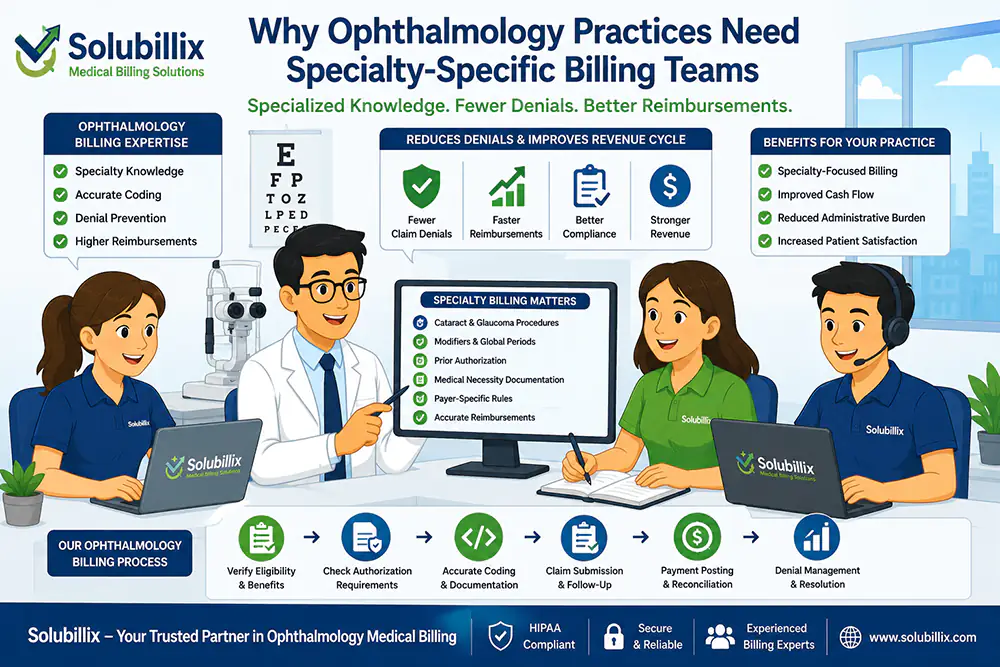
Ophthalmology is one of the most complex and high-value specialties in healthcare billing. From cataract surgeries to glaucoma management, even a small coding or documentation error can lead to claim denials, underpayments, or compliance risks.
That’s why general billing teams often struggle with ophthalmology revenue cycles. At Solubillix, we understand that ophthalmology requires a specialty-specific billing approach, not a generic medical billing process.
In this article, we explain why dedicated ophthalmology billing teams are essential to reduce denials, improve reimbursements, and maintain compliance.
1. Ophthalmology Billing Is Structurally Complex
Unlike many specialties, ophthalmology combines:
- Surgical procedures (cataract, glaucoma, retina procedures)
- Diagnostic testing (OCT, visual fields, fundus photography)
- Office visits (E/M coding)
- Global surgical packages
- Strict payer-specific rules
Each component follows different billing rules, making it easy for general billing teams to miss critical details.
Specialty-trained billing teams at Solubillix are built specifically to handle this complexity with accuracy and consistency.
2. High Risk of Denials Without Specialty Knowledge
Ophthalmology claims are frequently denied due to:
- Incorrect modifier usage (24, 25, 57, 59)
- Global period billing errors
- Missing medical necessity documentation
- Improper laterality coding
- Prior authorization failures
- Bundling/unbundling issues
These errors are not random—they usually come from lack of specialty understanding.
A specialty billing team reduces these risks by applying ophthalmology-specific rules before claim submission.
3. Cataract and Glaucoma Billing Requires Precision
Cataract and glaucoma procedures are among the most audited ophthalmology services.
For example:
- Cataract claims require strict visual acuity documentation
- Glaucoma procedures require long-term diagnostic history
- Both require accurate surgical coding and global period tracking
At Solubillix, we ensure every claim is reviewed with procedure-specific logic, reducing costly rejections and delays.
4. General Billing Teams Miss Ophthalmology-Specific Rules
Generic billing teams often:
- Treat ophthalmology like general surgery billing
- Miss payer-specific ophthalmology guidelines
- Overlook vision plan vs medical insurance differences
- Fail to manage bundled services correctly
This leads to inconsistent reimbursements and higher accounts receivable.
Specialty teams eliminate this gap by focusing only on ophthalmology workflows.
5. Faster Reimbursements Through Clean Claim Strategy
A specialty ophthalmology billing team improves:
- First-pass claim acceptance rates
- Coding accuracy before submission
- Eligibility verification quality
- Authorization tracking efficiency
- Denial prevention workflows
At Solubillix, we implement a clean-claim-first approach that helps practices reduce payment delays and stabilize cash flow.
6. Better Handling of Global Surgical Periods
Ophthalmology surgeries involve global periods that require strict compliance.
Common issues include:
- Billing follow-up visits incorrectly
- Missing modifiers for unrelated services
- Incorrect post-op coding timelines
Specialty billing teams track global periods precisely to avoid repeated denials and audit triggers.
7. Increased Revenue Through Reduced Underpayments
Many ophthalmology practices lose revenue due to:
- Undercoded procedures
- Missed billable services
- Incorrect fee schedules
- Improper bundling adjustments
A specialty billing team ensures every eligible service is captured and billed correctly, improving overall reimbursement performance.
8. Why Solubillix Is Built for Ophthalmology Billing
At Solubillix, we provide dedicated ophthalmology billing expertise designed to handle the full revenue cycle:
- Cataract & glaucoma billing support
- Ophthalmology-specific denial management
- Prior authorization handling
- Modifier and coding compliance
- Eligibility verification
- AR follow-up and recovery
- Specialty-focused revenue cycle optimization
Our goal is to help ophthalmology practices reduce administrative burden while maximizing revenue performance.
Final Thoughts
Ophthalmology billing is not just complex—it is highly specialized. Practices that rely on general billing teams often face higher denial rates, slower reimbursements, and compliance risks.
By partnering with a specialty-focused billing team like Solubillix, ophthalmology providers can significantly improve financial performance, reduce claim errors, and ensure smoother revenue cycle operations.