
Cardiology billing is entering 2027 with more than routine annual code updates. The CPT 2027 code set introduces hundreds of changes across medicine, including important updates affecting cardiovascular procedures and ventricular assist device reporting.
For cardiologists, coding teams, and revenue cycle managers, the challenge is not simply learning which codes are new. The bigger issue is making sure coding, documentation, payer policies, fee schedules, authorization workflows, and billing systems are ready before the first 2027 claim is submitted.
A code that is technically correct can still result in a denial when the payer’s reimbursement policy, authorization, documentation, or claim-edit logic has not been updated.
What Is Changing in CPT 2027?
The American Medical Association has released the CPT 2027 code set, which becomes effective January 1, 2027.
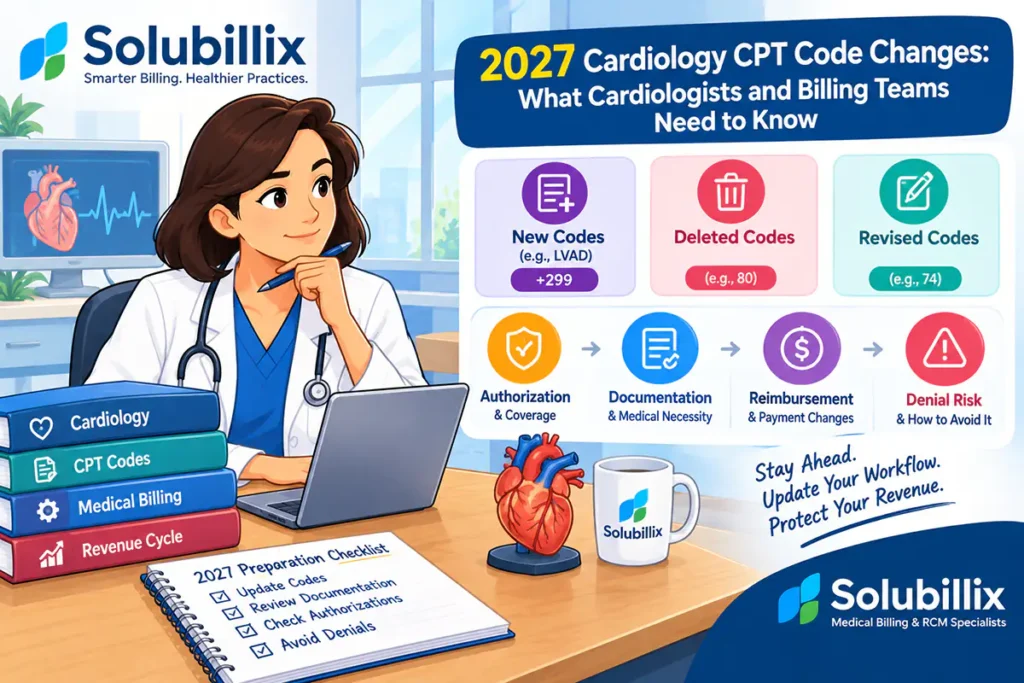
The complete update contains:
- 299 new CPT codes
- 74 revised codes
- 80 deleted codes
- Numerous changes to coding guidelines and reporting instructions
The AMA specifically identifies ventricular assist device procedures as one of the major areas affected in the 2027 update.
Three new codes involving left ventricular assist device procedures are being added, accompanied by revised cardiovascular-system guidelines.
For cardiology practices, this means 2027 preparation should begin before the first January claim—not after a denial appears.
1. New Ventricular Assist Device Reporting Changes
One of the most significant cardiology-related CPT changes involves left ventricular assist device (LVAD) procedures.
The 2027 CPT update adds three new codes for LVAD-related insertion and removal procedures and revises the associated cardiac-assist guidelines.
This is important because VAD procedures can involve complex surgical approaches, device-specific documentation, imaging, and multiple components of care.
Billing teams should not simply replace an old code with a new one.
Before submitting a 2027 claim, the coding team should verify:
- The exact procedure performed
- The type of ventricular assist device
- Whether the procedure involved insertion or removal
- The surgical approach
- The anatomical site or access used
- Whether radiological supervision or interpretation is included
- Whether additional services are separately reportable
- Applicable CPT parenthetical instructions
- NCCI and payer-specific edits
- Medicare and commercial payer reimbursement policies
The documentation should support the exact service being reported.
That becomes especially important when the new code structure differentiates procedures that previously required broader reporting.
2. Don’t Treat Every 2027 Change as a New Cardiology Code
This is an important distinction for billing teams.
The CPT 2027 release contains 299 new codes overall, but not all 299 are cardiology codes.
Some of the major 2027 changes involve maternity care, hernia repair, prostate biopsy, biofeedback, radiology, sleep medicine, and other specialties.
For cardiology practices, the focus should therefore be on identifying the changes that actually affect the services the practice performs.
A cardiology practice performing office-based E/M, echocardiography, stress testing, cardiac catheterization, device management, vascular procedures, or advanced cardiovascular procedures should create a specialty-specific implementation list rather than relying on a generic CPT update.
3. New Codes Can Create Documentation Problems
A new CPT code does not eliminate the need for documentation.
In fact, new or revised codes can increase documentation risk because providers and coders may initially interpret the new reporting requirements differently.
For procedures affected by the 2027 changes, documentation should clearly establish:
What was performed → how it was performed → why it was medically necessary → what was included → what was separately reportable.
For example, when reporting a complex cardiovascular procedure, the medical record may need to make the approach and procedural details clear enough for the coder to select the appropriate code.
A vague operative note can create a coding problem even when the physician performed the correct procedure.
4. Medicare Payment Changes Are Separate From CPT Code Changes
This distinction is critical.
CPT describes the service. Medicare payment policy determines how Medicare values and pays that service.
For 2027, CMS has issued a proposed Medicare Physician Fee Schedule rule containing several cardiology-related payment proposals.
The proposal addresses areas including:
- Tricuspid valve procedures
- Left atrial appendage closure
- Coronary intravascular ultrasound
- Cardiac contractility modulation
- Ventricular assist device procedures
- Other physician services and payment methodologies
For example, CMS proposed specific valuation changes affecting several cardiovascular services, while accepting the recommended valuation for the three new ventricular assist device codes.
These proposals are not the same thing as finalized 2027 reimbursement.
Billing teams should therefore distinguish between:
- The CPT code becoming effective January 1, 2027
- The Medicare payment amount assigned to that service
- Commercial payer reimbursement
- Medicare Advantage reimbursement
- Medicaid reimbursement
- Payer-specific coverage and authorization rules
A new CPT code does not automatically guarantee the same reimbursement across every payer.
5. Payer Policies May Not Change at the Same Time
This is one of the areas most likely to create problems during the first few months of a new code year.
A practice may update its EHR and clearinghouse with a new CPT code, but the payer may have separate requirements for:
- Prior authorization
- Medical necessity
- Provider specialty
- Place of service
- Diagnosis combinations
- Modifiers
- Documentation
- Coverage
- Reimbursement
- Claim submission
This means a successful internal code update does not necessarily mean the payer is ready to process the claim exactly as expected.
For high-dollar cardiology procedures, billing teams should verify payer implementation instructions before January 1 whenever possible.
6. Review Your EHR and Practice Management System Before January
One of the most overlooked parts of an annual CPT update is the technology side.
Before 2027 claims are submitted, cardiology practices should review:
- CPT code tables
- Charge masters
- Fee schedules
- Claim scrubbing rules
- EHR preference lists
- Procedure templates
- Authorization systems
- Clearinghouse edits
- Payer-specific billing rules
- Superbill or charge-entry workflows
- Coding software
- Internal denial rules
If an old code remains active in a charge master after January 1, the problem may not appear until the claim reaches the payer.
That can create unnecessary delays in reimbursement.
7. Review Deleted and Revised Codes—Not Just New Codes
Many practices focus heavily on new CPT codes and overlook deleted or revised codes.
That can be costly.
When a code is deleted or substantially revised, the billing team should determine:
What was used in 2026?
↓
Was the code deleted, revised, or replaced for 2027?
↓
What should be reported beginning January 1, 2027?
↓
Does the payer require a different authorization or billing structure?
↓
Does the EHR/clearinghouse need an update?
This simple process can prevent claims from being submitted with outdated codes.
8. Watch for Authorization Mismatches
Prior authorization is another potential source of cardiology claim denials during a code transition.
Suppose a procedure was authorized under a 2026 code but performed on or after January 1, 2027.
The practice should not automatically assume that the old authorization will process correctly with the new CPT code.
Depending on the payer and procedure, the billing team may need to verify whether:
- The authorization automatically maps to the new code
- The authorization needs modification
- A new authorization is required
- The payer has issued a crosswalk
- The procedure remains authorized under the same clinical criteria
This is particularly important for expensive cardiovascular procedures where a single authorization issue can create a significant receivable balance.
9. Don’t Assume Medicare and Commercial Payers Will Pay the Same Way
A common billing mistake is assuming that Medicare’s treatment of a new CPT code automatically applies to every commercial payer.
It does not.
Commercial insurers may establish their own:
- Fee schedules
- Coverage policies
- Medical policies
- Prior authorization requirements
- Bundling rules
- Modifier requirements
- Medical necessity criteria
- Effective dates
A cardiology billing team should therefore maintain a payer-specific implementation checklist rather than relying exclusively on the Medicare Physician Fee Schedule.
10. The First 90 Days of 2027 Deserve Extra Attention
The first few months after a CPT change are particularly important for revenue cycle teams.
A practice should monitor 2027 claims for:
- Invalid or deleted CPT codes
- Incorrect code combinations
- Authorization mismatches
- Medical necessity denials
- Modifier errors
- Bundling edits
- Payer-specific code exclusions
- Unexpected reimbursement changes
- Claims suspended for manual review
- Incorrect fee schedule amounts
Instead of simply working denials individually, billing managers should look for patterns.
For example:
If 15 claims for the same cardiovascular procedure suddenly deny after January 1, the problem may not be physician documentation.
It could indicate:
- A payer has not loaded the new code correctly
- The clearinghouse is using an outdated edit
- The authorization system is still using the 2026 code
- The payer requires a different modifier
- The practice’s charge master was not updated
- The payer has changed its reimbursement policy
Pattern analysis can prevent the same billing problem from repeating across dozens of claims.
11. What Cardiology Practices Should Do Before January 1, 2027
A practical preparation checklist can help practices avoid preventable claim problems.
CPT 2027 Preparation Checklist
1. Identify affected services
Determine which 2027 CPT changes apply to the procedures your cardiologists actually perform.
2. Review new, revised, and deleted codes
Do not focus only on new codes. Review every code currently used by the practice that appears in the 2027 update.
3. Update the charge master
Make sure obsolete codes are removed or retired and applicable 2027 codes are available for charge entry.
4. Review documentation templates
Ensure procedure notes contain the information required to support the new or revised reporting structure.
5. Check authorization workflows
Determine whether existing authorizations need to be updated for 2027 services.
6. Verify payer policies
Check Medicare, Medicare Advantage, commercial, and Medicaid requirements separately.
7. Update fee schedules
Review expected reimbursement and compare it with payer contracts where appropriate.
8. Test claim submission
Send test claims through the applicable EHR and clearinghouse workflows before the new codes become routine.
9. Monitor early denials
Track 2027 denials by CPT code, payer, diagnosis, modifier, and denial reason.
10. Educate providers and coders
Make sure physicians, coders, charge-entry staff, and billing teams understand the changes that actually affect the practice.
A Simple Example
Imagine a cardiology practice performs an LVAD-related procedure in January 2027.
The physician documents the procedure correctly, but the billing team submits the claim using an outdated 2026 code.
The payer rejects the claim.
The billing team corrects the CPT code and resubmits it, but the authorization was also tied to the previous coding structure.
The corrected claim now creates a second problem.
This illustrates why CPT implementation cannot be treated as a simple “replace old code with new code” exercise.
Coding, authorization, documentation, payer policy, and reimbursement must be reviewed together.
Why 2027 CPT Changes Matter to Cardiology Revenue Cycle Management
CPT changes can affect much more than coding.
They can influence:
- Claim acceptance
- Claim reimbursement
- Prior authorization
- Medical necessity review
- Documentation requirements
- Payer edits
- Denial rates
- Accounts receivable
- Provider workflow
- Patient billing
For cardiology practices performing high-value procedures, even a small coding or payer-policy issue can create a substantial financial impact.
That is why the best preparation happens before the first 2027 claim is submitted.
How Solubillix Helps Cardiology Practices Prepare for 2027
At Solubillix, medical billing is not limited to submitting claims.
Our revenue cycle approach focuses on the entire billing process—from charge capture and coding review to claim submission, payment posting, denial management, and insurance follow-up.
For cardiology practices preparing for 2027, our team can help identify potential billing issues involving:
- CPT code changes
- Claim rejections
- Coding-related denials
- Authorization problems
- Payer-specific requirements
- Underpayments
- Incorrect claim processing
- Accounts receivable
- Payment discrepancies
The goal is simple: help cardiology practices identify revenue-cycle problems before they become recurring denials.
Frequently Asked Questions
When do the CPT 2027 changes take effect?
The CPT 2027 code set takes effect January 1, 2027.
How many new CPT codes are in the 2027 update?
The AMA reports 299 new CPT codes, along with 74 revised codes and 80 deleted codes.
Are there cardiology-specific changes in CPT 2027?
Yes. The AMA specifically identifies ventricular assist device procedures among the major 2027 updates, including three new codes involving left ventricular assist devices and revised reporting guidelines.
Will every cardiology practice need to use the new VAD codes?
No. The changes are relevant to practices reporting the affected procedures. Practices should identify the 2027 changes applicable to the services they actually perform.
Will Medicare and commercial insurers reimburse new CPT codes the same way?
Not necessarily. CPT establishes the coding language, while individual payers determine coverage, reimbursement, authorization, and other claim-processing requirements.
Are the 2027 Medicare payment changes final?
Not all of them. CMS’s CY 2027 Physician Fee Schedule information currently includes proposed policies. Practices should verify the final CMS rule and payer-specific payment policies before relying on proposed reimbursement amounts.
Final Takeaway
The most important 2027 cardiology billing change is not simply the arrival of new CPT codes.
The real challenge is making sure the code, documentation, authorization, payer policy, fee schedule, and claim workflow all remain aligned.
Cardiology practices that wait until the first denial appears may spend January and February fixing preventable billing problems.
Preparing the revenue cycle before January 1, 2027 can help reduce avoidable rejections, coding-related denials, authorization issues, and reimbursement delays.
For cardiology billing, the 2027 CPT update should be treated as a revenue-cycle implementation project—not just a coding update.