
Introduction: The Growing Role of TMS in Modern Mental Health Care
Transcranial Magnetic Stimulation (TMS) therapy is one of the most significant advancements in mental health treatment. It offers a non-invasive, FDA-approved option for patients struggling with Major Depressive Disorder (MDD) and other neurological or psychiatric conditions that do not respond to traditional therapies.
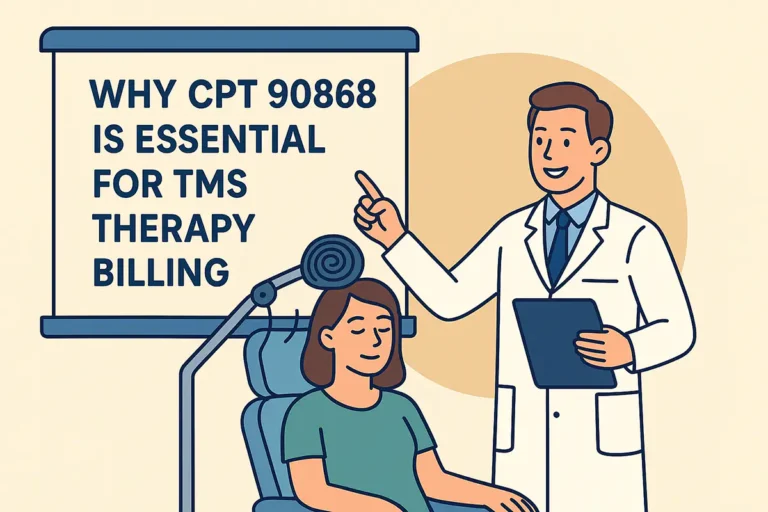
As TMS grows in clinical adoption, the need for accurate billing and compliance has become even more critical. Among all the procedural codes, CPT 90868 stands out as the core billing code that ensures correct reimbursement and full regulatory alignment for every TMS session.
At Solubillix, we understand that even the smallest coding error can lead to denials, compliance issues, and revenue loss. That’s why understanding what CPT 90868 represents — and why no other code can replace it — is essential for every provider, medical biller, and revenue cycle management (RCM) professional working in behavioral health.
Understanding CPT 90868
CPT 90868 is officially defined as:
“Therapeutic repetitive transcranial magnetic stimulation (TMS) treatment; subsequent delivery and management, per session.”
In simpler terms, this code represents each individual TMS treatment session that takes place after the initial mapping and motor threshold determination (coded separately as 90867).
Each time a patient return for a TMS session, the provider supervises the treatment, monitors the patient’s response, and ensures parameters remain within therapeutic range. CPT 90868 captures the professional time, oversight, and clinical management that occur during each of these sessions.
Why CPT 90868 Is So Important in TMS Billing
1. Ensures Accurate and Fair Reimbursement
TMS therapy requires both advanced equipment and clinical supervision. CPT 90868 is specifically designed to cover the therapeutic delivery and professional management aspects of each session.
Without this code, providers could not be reimbursed accurately for their time and clinical oversight. In other words, 90868 protects both the provider’s financial integrity and the payer’s compliance standards by ensuring the service is coded consistently nationwide.
2. Recognized by All Major Payers
Both Medicare and commercial payers such as UnitedHealthcare, Blue Cross Blue Shield, Aetna, and Cigna recognize CPT 90868 as the only valid billing code for ongoing TMS therapy sessions.
Because it is an established and well-defined CPT code, it eliminates confusion and minimizes denials — as long as the documentation supports medical necessity and proper supervision.
3. Captures Clinical Oversight, Not Just Device Use
TMS therapy is not a simple device-driven service. It requires continuous clinical evaluation, patient feedback assessment, and treatment adjustments during each session.
CPT 90868 accounts for this therapeutic management performed by a qualified healthcare professional. It differentiates TMS from other procedures like electroconvulsive therapy (ECT) or psychotherapy, ensuring it is recognized as a unique clinical service.
4. Supports Compliance and Audit Readiness
Each 90868 session must be properly documented to demonstrate compliance with payer and CMS standards. Key documentation elements include:
- Date and duration of treatment
- Provider presence and supervision
- Equipment settings or parameter adjustments
- Patient tolerance and response to treatment
Accurate documentation not only supports clean claim submission but also safeguards the practice during audits or payer reviews.
Why There’s No Replacement for CPT 90868
Despite advancements in neurostimulation therapies, there is currently no replacement or alternative CPT code for 90868. The reasons are deeply rooted in how the code was defined, structured, and approved by the American Medical Association (AMA).
1. Technology-Specific Procedure
TMS therapy uses magnetic pulses to target specific brain regions linked to mood regulation. Its method of action and therapeutic process are entirely different from ECT or psychotherapy.
Therefore, CPT 90868 was created to uniquely define TMS procedures. Any attempt to replace it would require an entirely new category of CPT codes, which the AMA has not introduced.
2. Part of a Defined TMS Code Set
The AMA has established only three procedural codes for TMS therapy:
- 90867 – Initial treatment with motor threshold determination and mapping
- 90868 – Subsequent treatment delivery and management (per session)
- 90869 – Re-determination of motor threshold for continued treatment
These three codes cover the complete clinical process from start to finish. Because they already capture the scope of TMS services comprehensively, there’s no need for an additional or replacement code.
3. Compliance and Regulatory Alignment
Using any alternate or unlisted psychiatric code instead of 90868 can create noncompliance risks, as it misrepresents the service being rendered. Insurers and regulators expect TMS therapy to be billed only under its defined CPT structure.
In fact, billing an incorrect or generalized code may lead to claim rejections, payment delays, or even audit triggers. Maintaining CPT 90868 ensures your claims remain compliant and properly categorized.
Common Errors Practices Make with TMS Billing
Even though CPT 90868 is straightforward, many practices experience denials due to avoidable errors. Some of the most common include:
- Billing 90868 without a corresponding 90867 for the initial session
- Missing or incomplete documentation for the treating provider’s supervision
- Using modifiers incorrectly or failing to update payer-specific requirements
- Lack of clinical notes linking sessions to a valid diagnosis of major depressive disorder (MDD) or another approved indication
At Solubillix, our RCM experts help practices avoid these pitfalls through pre-claim audits, documentation reviews, and payer-specific compliance checks.
Best Practices for Compliant TMS Billing
To ensure accurate and compliant billing for TMS therapy:
- Use 90867 for the first treatment session (motor threshold mapping).
- Use 90868 for each subsequent therapy session.
- Use 90869 only when re-determining motor threshold is medically necessary.
- Maintain detailed documentation of supervision, patient response, and any adjustments.
- Stay updated with payer-specific TMS coverage policies and medical necessity criteria.
- Conduct periodic internal audits to ensure clean claims and reduce denial rates.
How Solubillix Ensures Accuracy and Compliance
At Solubillix, we specialize in psychiatric and behavioral health billing, including advanced services like TMS therapy. Our experienced billing experts and compliance specialists:
- Review medical documentation before claim submission
- Validate CPT and modifier usage
- Ensure payer-specific rules are met for pre-authorization and continued care
- Track denials and appeal efficiently to protect your revenue
We combine expertise, technology, and compliance-driven workflows to make sure your TMS billing process remains clean, accurate, and profitable.
Conclusion: The Future of TMS Billing
CPT 90868 is not just a code — it’s the backbone of TMS therapy billing and reimbursement integrity. It ensures providers receive proper payment for the clinical oversight and therapeutic management that make TMS such a valuable mental health treatment.
Until the AMA or CMS issues a new procedural framework, 90868 will continue to serve as the gold standard for reporting TMS sessions.
For providers, clinics, and billing professionals, mastering this code means mastering compliance, revenue protection, and operational efficiency.
If your practice offers TMS therapy, partner with Solubillix to streamline your billing process, reduce denials, and ensure every session is reimbursed the right way — compliantly and confidently.