
In the world of healthcare revenue cycle management (RCM), understanding the difference between Claim Adjustment Reason Codes (CARCs) and Remittance Advice Remark Codes (RARCs) is essential. Although they often appear together on EOBs and ERAs, they serve very different purposes. Misinterpreting them leads to incorrect follow-ups, unnecessary rework, and preventable claim denials.
This guide explains both codes in depth—what they mean, how payers use them, and how Solubillix helps you resolve and prevent these issues as part of a compliance-aligned billing workflow.
What Are Reason Codes (CARCs)?
Claim Adjustment Reason Codes (CARCs) explain why a claim or service line was paid, denied, or adjusted.
These codes are created and maintained by X12 and are used universally across commercial payers, Medicaid, and Medicare.
Purpose of CARCs
CARCs specifically state:
- Why payment was changed
- What part of the claim was affected?
- Whether additional action is required by the provider
- Compliance or eligibility impacts on the payment
Key Characteristics
| Attribute | Description |
| Authority | HIPAA-mandated X12 standard |
| Focus | Payment decision (denied, reduced, applied to patient responsibility) |
| Action Required? | Yes — CARCs usually require billing staff follow-up |
| Appeal Relevance | Essential for appeal letters and corrections |
Examples of CARCs
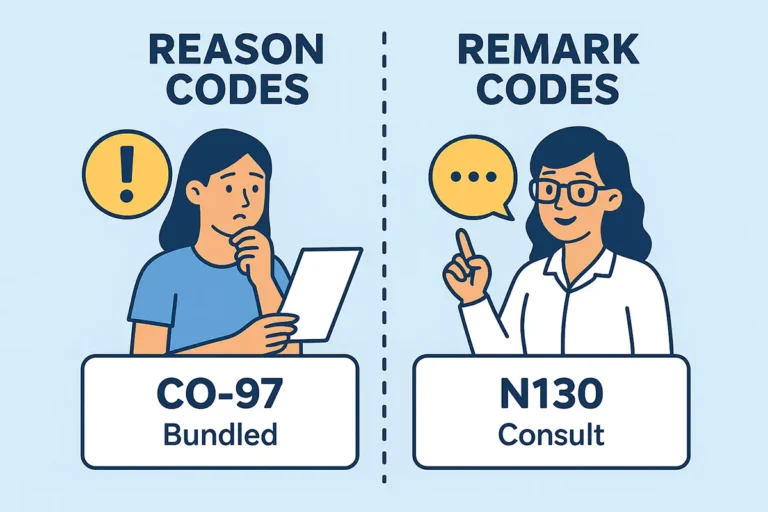
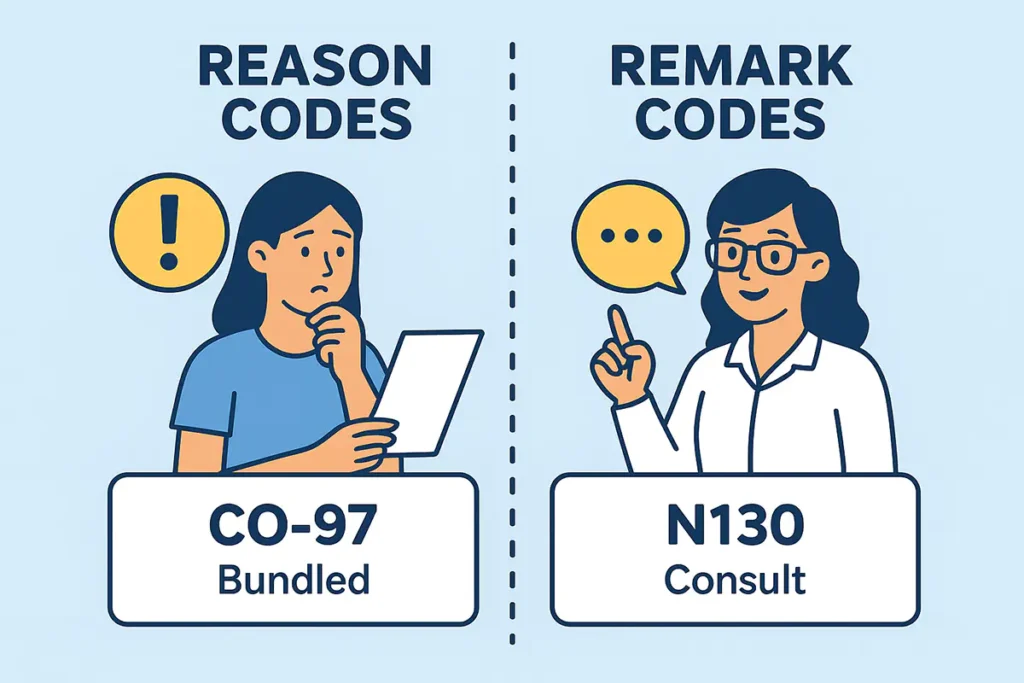
- CO-97: Service not paid because payer considers it bundled
- CO-150: Payer deems the service not medically necessary
- CO-151: Frequency limit exceeded
- PR-1: Deductible applied
These codes directly impact the payment outcome and must be corrected or appealed appropriately.
What Are Remark Codes (RARCs)?
Remittance Advice Remark Codes (RARCs) provide additional informational messages to supplement CARCs.
They do not determine payment but give clarity, context, and guidance.
RARCs are issued and maintained by CMS.
Purpose of RARCs
RARCs explain:
- Additional details about the claim
- Missing information
- Policy references
- Documentation issues
Key Characteristics
| Attribute | Description |
| Authority | CMS |
| Focus | Extra details about the adjustment |
| Action Required? | No — but helpful for understanding the denial |
| Appeal Relevance | May support the reason behind CARC denial |
Examples of RARCs
- N130: Consult Payer for More Information
- MA61: Missing certificate of medical necessity
- M20: Missing/invalid claim information
- N289: Duplicate claim/service already submitted
RARCs help the biller understand what else is involved, but they are not the primary decision code.
Key Differences: Reason Codes vs. Remark Codes
Below is a quick comparison:
| Feature | Reason Code (CARC) | Remark Code (RARC) |
| Defines payment outcome | ✔ Yes | ✖ No |
| Explains denial reason | ✔ Yes | ✔ Sometimes |
| Provides supplemental information | ✖ No | ✔ Yes |
| Standardized by | X12 | CMS |
| Used for appeals | ✔ Essential | Optional supporting info |
| Triggers corrective action | ✔ Yes | ✖ Not always |
Example Scenario
CARC CO-151: Frequency limit exceeded (main denial reason)
RARC N130: Consult payer’s coverage policy for frequency guidelines
The CARC tells you why it was denied.
The RARC tells you extra details to help fix it.
Why Both Codes Matter in RCM
Billing teams must correctly interpret CARCs and RARCs because:
- Incorrect understanding leads to wrong corrections
- Appeals may be rejected without proper CARC reference
- Front-end staff may repeat errors if remark messages are ignored
- Audits require accurate tracking of denial trends
Together, they provide a complete picture of payer decisions.
How to Use CARCs and RARCs Effectively
1. Understand the Denial Pattern
Group denials by:
- CARC type
- Payer
- Provider
- CPT code
This helps identify systemic issues such as documentation gaps or front-desk eligibility errors.
2. Review Both Codes Together
Always read CARC + RARC together.
CARC = primary denial
RARC = supporting detail
3. Identify Corrective Action
Depending on the CARC:
- Add modifiers
- Resubmit with corrected units
- Obtain missing prior authorization
- Add medical necessity documentation
- Correct patient insurance details
RARCs often guide what’s missing or what policy applies.
4. Strengthen Billing Compliance
Payers expect providers to follow:
- Frequency guidelines
- Modifier rules
- Documentation standards
- Bundling and unbundling policies
Correctly interpreting codes helps avoid audit risks.
How Solubillix Helps You Manage Reason Codes & Remark Codes Efficiently
Solubillix is designed to simplify and automate denial handling, frequency logic, and compliance accuracy. Here’s how:
✨ Smart Denial Categorization
The system groups denials by:
- Payer
- Provider
- CPT/HCPCS
- Frequency patterns
- Documentation issues
Helping you track denial trends and eliminate recurring issues.
✨ Actionable Resolution Recommendations
For each CARC/RARC, Solubillix provides:
- What needs correction
- Whether an appeal is required
- Missing documentation alerts
- Coding/modifier guidance
This reduces rework and speeds up reimbursement.
Conclusion
Reason Codes (CARCs) explain why a payer adjusted or denied a claim, whereas Remark Codes (RARCs) offer additional context or instructions. Both are essential for accurate claim corrections, appeals, and denial prevention.
With Solubillix’s automated denial tools, smart scrubbing logic, and compliance-driven workflows, billing teams can confidently interpret CARCs and RARCs—reducing errors, improving clean claim rates, and accelerating revenue recovery.