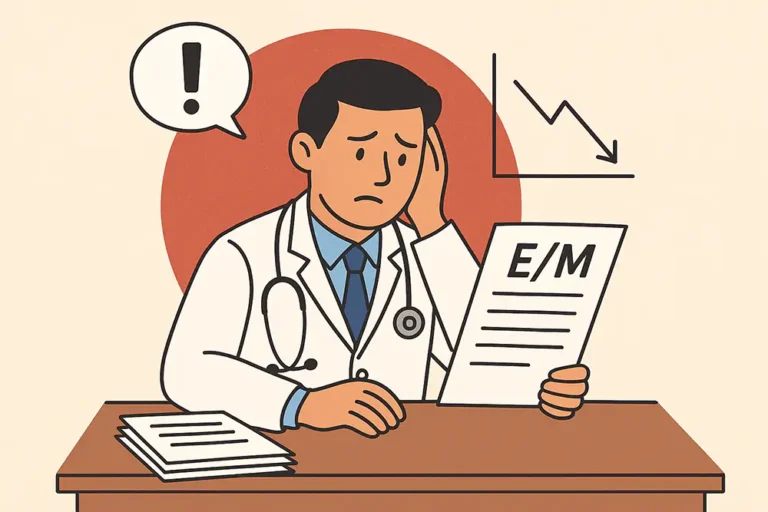

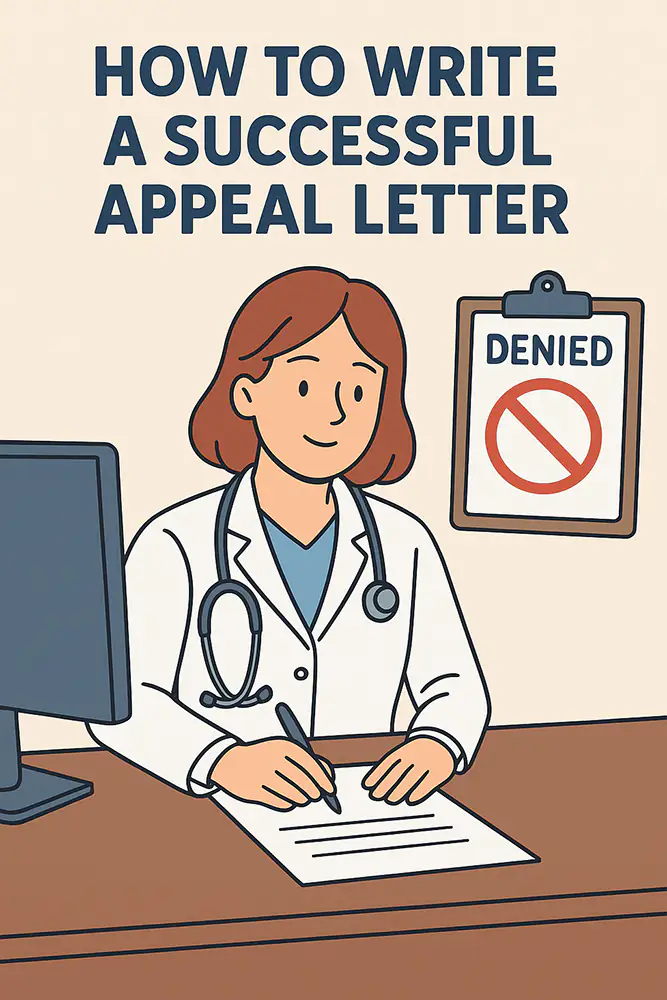
Denied claims cost medical practices thousands every month. But here’s the good news: over 60% of claim denials can be overturned with the right appeal strategy. The key is writing a clear, persuasive, payer-compliant appeal letter that includes supporting documentation and strong justification.
This complete guide gives you everything you need — step-by-step instructions, expert tips, and a full appeal letter template rewritten and designed to help providers recover lost revenue quickly.
Why Appeal Letters Matter More
Insurance companies are tightening their policies, leading to:
- More documentation-based denials
- Stricter coding and modifier requirements
- Automated claim edits
- Shorter appeal submission deadlines
This means your appeal letter must be accurate, timely, persuasive, and fully compliant. A weak or generic appeal wastes time. A strong appeal recovers revenue that your practice rightfully earned.
When Should You Write an Appeal Letter?
You should send an appeal when a claim is denied due to:
- Incorrect application of payer policy
- Lack of medical necessity (when documentation supports it)
- Bundling errors
- Modifier issues
- Coding discrepancies
- Eligibility misunderstandings
- Missing or unclear documentation
- “Service not covered” when it actually is under the plan
- Prior authorization claimed as missing when it was obtained
Most of these denials are reversible — if appealed correctly.
What Every Successful Appeal Letter MUST Include
A strong appeal letter contains:
✔ 1. Patient & claim information
Clear, structured identifiers (name, DOB, claim #, DOS).
✔ 2. Explanation of the denial
Quote or reference the payer’s denial reason.
✔ 3. Strong rebuttal
Explain exactly why the denial is incorrect.
✔ 4. Supporting evidence
Attach:
- Clinical documentation
- Provider notes
- Prior authorization numbers
- Operative reports
- Corrected coding references
- Payer policy excerpts
- EOB & denial code
✔ 5. Request for reconsideration
Directly ask for claim reversal.
✔ 6. Compliance language
Showing familiarity with payer guidelines adds authority.
✔ 7. Provider signature
Proof that the appeal is legitimate and compliant.
Solubillix follows this structure for every appeal — which is why our overturn rate is exceptionally high.
Expert Tips to Increase Your Appeal Success Rate
⭐ Tip 1: Quote the payer’s own policy
When you use their rules to justify your claim, approvals increase dramatically.
⭐ Tip 2: Attach precise documentation
Missing supporting documents = automatic denial.
⭐ Tip 3: Keep the appeal under one page
Decision teams review fast. Clarity wins.
⭐ Tip 4: Always restate medical necessity
The clinical picture should support the billed service.
⭐ Tip 5: Use corrected coding only when applicable
Never resubmit incorrect codes without an explanation.
⭐ Tip 6: Send appeals electronically whenever possible
Speeds up reconsideration by 30–50%.
📄 Medical Appeal Letter Template
[Provider Name]
[Practice Name]
[Address]
[City, State ZIP]
[Phone Number]
[Fax]
[Date]
RE: Claim Appeal Request – [Patient Name], [DOB], [Insurance ID]
Claim Number: []
Date of Service: []
Denial Code: [________]
Dear Claims Review Department,
I am writing to formally appeal the denial of the above claim for [service/procedure] provided on [DOS]. The denial reason listed as “[insert denial text exactly as shown on the EOB]” does not accurately reflect the clinical documentation or the payer’s medical policy.
1. Reason for Appeal
The service rendered was medically necessary, appropriately documented, and fully compliant with your coverage criteria. According to your policy [insert payer policy or guideline reference], this service meets the required standards for reimbursement.
2. Supporting Documentation Included
Enclosed with this appeal are:
- Provider clinical notes
- Operative/procedure report
- Prior authorization confirmation (if applicable)
- Corrected claim form (if required)
- Relevant diagnostic results
- Copy of original EOB
These documents demonstrate that the patient required the service and that it was performed accurately in accordance with medical guidelines.
3. Request for Reconsideration
Based on the provided evidence and supporting policy documentation, I respectfully request that the denial be overturned and the claim reprocessed for appropriate reimbursement.
If additional information is needed, please contact our office at [phone].
Thank you for your prompt attention.
Sincerely,
[Provider/Authorized Representative Name]
[Title]
[Practice Name]
Checklist Before Sending Your Appeal
Before submitting, always verify:
✔ Correct claim number
✔ DOS matches documentation
✔ PA number included
✔ All documentation attached
✔ Appeal submitted within payer deadline
✔ Correct mailing or fax address
✔ Clear explanation supporting overturn
✔ Signed and dated letter
Solubillix uses a 25-point internal checklist to ensure error-free appeals — resulting in high denial overturn success rates.
Why Practices Let Solubillix Handle Their Appeals
Denials require time, precision, and payer knowledge. Solubillix excels because:
✔ We analyze every denial within 24–48 hours
✔ Appeals include payer-specific language
✔ We use supporting documentation to strengthen approval
✔ We track all appeal deadlines
✔ Each case is followed until resolved
✔ We provide monthly denial trend reports
✔ We identify—and prevent—future denials
This proactive system saves practices significant time and prevents revenue loss.
⭐ Conclusion
Writing a strong appeal letter is not just about disputing a denial — it’s about presenting a clear, organized, evidence-based argument that supports reimbursement. With the right template and documentation, providers can recover thousands in unpaid claims.
Solubillix helps practices reduce denials, increase overturn success, and strengthen their entire revenue cycle process.
want Expert Help Overturning Denied Claims?
Solubillix offers:
- Free denial audit
- Free appeal strategy consultation
- 24–48 hour denial review turnaround
- Full-service denial & appeals management
👉 Book a Free Denial Review Today
👉 See How Much Money Your Practice Is Losing — And How We Can Recover It