
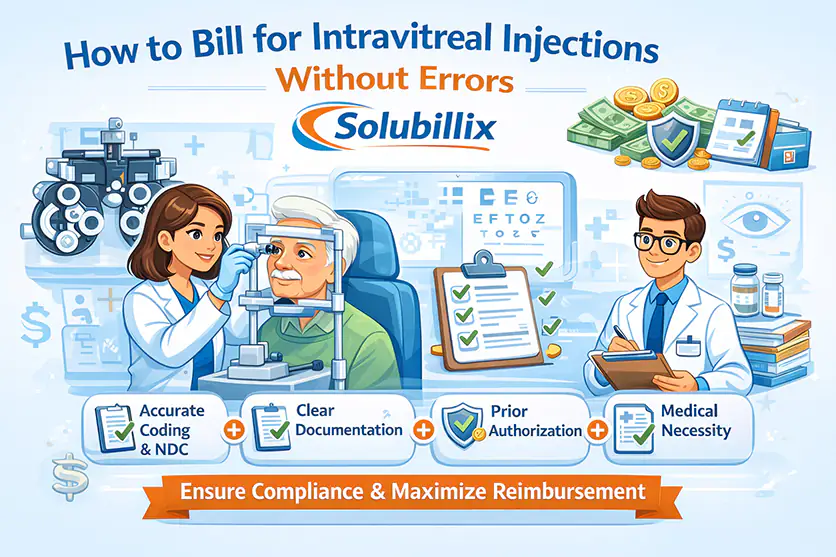
Intravitreal injections are among the most frequently performed procedures in ophthalmology, particularly for the treatment of retinal conditions such as macular degeneration, diabetic macular edema, and retinal vein occlusion. While clinically routine, billing for intravitreal injections can be administratively complex due to payer-specific coding requirements, drug documentation standards, and reimbursement guidelines.
At Solubillix, we have observed that even experienced ophthalmology practices often encounter claim denials due to minor billing errors associated with intravitreal injection procedures. Understanding the correct billing process is essential to ensure timely reimbursement and avoid compliance risks.
Understanding the Intravitreal Injection Billing Process
Billing for intravitreal injections involves two primary components:
- The procedure itself
- The medication administered
Each component must be reported accurately on the claim to avoid reimbursement delays or denials.
The procedure is typically billed using:
- CPT Code 67028 – Intravitreal injection of a pharmacologic agent
However, submitting the procedure code alone is not sufficient for payment approval.
Accurate Drug Coding Is Essential
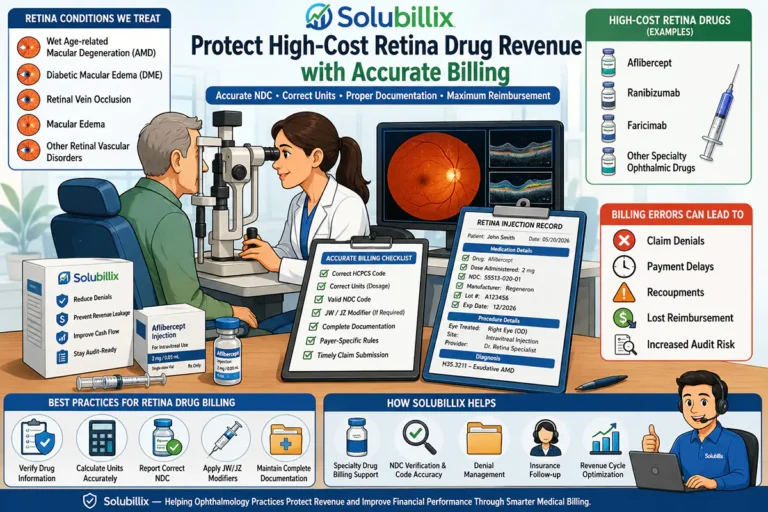
In addition to the procedure code, ophthalmology practices must report the medication using the appropriate HCPCS Level II code that corresponds to the specific drug administered.
Common billing challenges include:
- Using an incorrect drug code
- Failing to document the administered dosage
- Billing for discarded medication incorrectly
- Not including National Drug Code (NDC) information when required
Payers often deny claims if the drug billing information does not match the clinical documentation.
Proper Documentation Requirements
To support medical necessity, the patient’s medical record must clearly indicate:
- Diagnosis supporting treatment
- Medication name and dosage
- Route of administration
- Injection site (right eye, left eye, or bilateral)
- Date of service
- Physician’s order
Incomplete or vague documentation may result in claim rejection even when coding appears accurate.
Correct Use of Modifiers
Modifiers play a critical role when billing intravitreal injections. Incorrect or missing modifiers may prevent claims from processing appropriately.
For example:
- RT – Right eye
- LT – Left eye
- 50 – Bilateral procedure
Appending the appropriate modifier helps indicate which eye received treatment and whether the procedure was performed on one or both eyes.
Avoiding Common Billing Errors
Ophthalmology practices frequently experience denials due to:
- Missing laterality information
- Incorrect linkage between diagnosis and procedure
- Improper billing for multiple injections
- Failure to meet payer documentation requirements
- Incorrect billing of medication units
Each of these issues can significantly impact reimbursement timelines.
Verify Payer-Specific Requirements
Insurance carriers may have unique billing and prior authorization guidelines for injectable medications. Some payers require:
- Prior authorization before treatment
- Specific drug wastage reporting
- Supporting clinical documentation
Failure to meet these requirements often results in claim denials or requests for additional information.
Importance of Coordination Between Clinical and Billing Teams
Billing accuracy for intravitreal injections depends on effective communication between clinical staff and billing professionals. Ensuring that all necessary procedure and medication details are documented at the time of service helps reduce the risk of claim errors during submission.
How Solubillix Helps Ophthalmology Practices Bill Intravitreal Injections Accurately
Given the complexity of ophthalmology procedure billing, outsourcing to a specialized medical billing partner can significantly reduce administrative workload and improve claim acceptance rates.
Solubillix offers:
- Procedure and drug coding review
- Modifier accuracy verification
- NDC reporting support
- Prior authorization assistance
- Denial management services
- Compliance monitoring
Our ophthalmology billing specialists ensure that intravitreal injection claims are submitted accurately and in accordance with payer guidelines.
Improve Reimbursement and Reduce Denials with Solubillix
Accurate billing for intravitreal injections is essential for maintaining financial stability in ophthalmology practices. By minimizing coding errors and ensuring complete documentation, providers can improve reimbursement timelines and reduce administrative burden.
Partner with Solubillix to streamline your ophthalmology billing workflow and optimize your revenue cycle performance.