
Primary care practices are the backbone of the healthcare system—yet they are also some of the most underpaid due to preventable billing mistakes. Insurance guidelines are stricter, documentation errors are more heavily audited, and payers are increasingly using automated denial algorithms.
But after analyzing thousands of primary care claims, one issue consistently stands out as the #1 mistake causing lost revenue:
⭐ Incorrect or Incomplete Coding for Evaluation & Management (E/M) Services
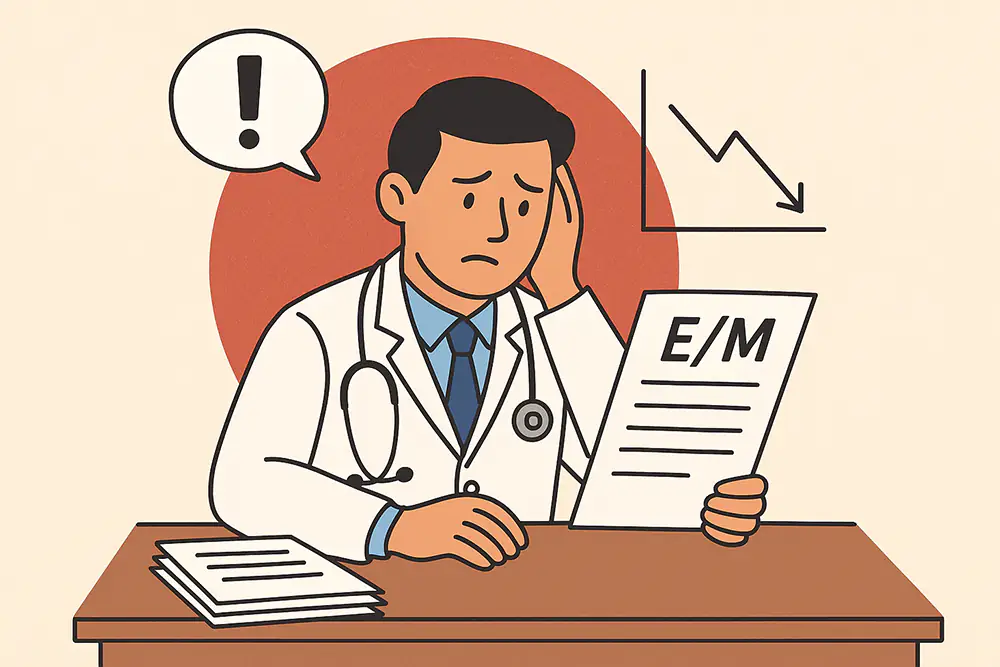
More than 60% of primary care revenue leaks come from mis-coded or under-coded E/M visits—not because providers lack clinical skill, but because documentation doesn’t match coding rules or teams don’t fully understand E/M complexity guidelines.
🔍 Why E/M Coding Is the #1 Cause of Revenue Loss
### 1. Most Primary Care Visits are Under-Coded
Studies show that over 40% of established patient visits are coded one level lower than warranted.
Example: A provider spends 35 minutes on a visit but bills a 99213 instead of a 99214.
Lost revenue per visit: $30–$55
Lost revenue per year (avg. provider): $25,000–$80,000+
### 2. Documentation Doesn’t Match Medical Decision Making (MDM)
Post-2021 E/M guidelines revolve around MDM or time, and not the old checklist system.
But many providers still document like the old system—leading to:
- Missing risk details
- Missing chronic condition management notes
- Missing data review or tests ordered
- Not documenting medication adjustments
- Not mentioning social determinants affecting care
If documentation doesn’t support complexity → claim is down-coded or denied.
### 3. Poor Understanding of “Time-Based Billing” Rules
Primary care providers routinely spend 30–40 minutes on visits (especially chronic disease management) but seldom bill based on time.
Time-based billing applies when:
- More than 50% of time is spent on counseling or coordination
- Total time on the date of service is documented
- Time includes chart review, orders, interpretation, care coordination
Most providers do not document total visit time → lost revenue every day.
### 4. Incorrect Use of Modifier 25
Modifier 25 is essential in primary care to separate preventive services from problem-oriented services.
Example:
A patient comes for an annual exam, but also has asthma, diabetes, or a rash requiring diagnosis and treatment.
You must bill both:
- Preventive service (e.g., 99396)
- Problem-oriented E/M with modifier 25
But many practices either:
❌ Forget to add modifier 25
❌ Don’t bill the problem-oriented E/M at all
❌ Fear audits and under-bill
Outcome: Thousands lost each month.
### 5. Lack of Updated Guidelines Knowledge
E/M guidelines changed drastically in 2021 and again in 2023 & 2024.
Yet many practices still operate with old templates and outdated coding logic.
This leads to:
- Downcoded claims
- Inaccurate MDM scoring
- Wrong CPT level selection
- Higher denial rates for complexity mismatch
🧩 Real Example: How a Simple E/M Fix Increased Revenue by 32%
A primary care clinic in Texas brought in Solubillix-style billing support.
Before:
- Average code used: 99213
- Average revenue/visit: ~$88
After correction:
- Proper documentation + coding
- Increased use of 99214 when appropriate
- Correct modifier 25 usage
- Clean claims rate: 98%
New average revenue/visit: ~$127
Annual increase (1 provider): $97,000+
This is real, common, and fixable.
🚨 Other Mistakes That Feed Into the E/M Revenue Loss
While E/M is the primary reason for lost revenue, it connects with several side issues:
1. Poor Insurance Verification
Wrong copays, wrong coverage, or expired plans → instant denial.
2. Missing Documentation for Chronic Care
A visit that should be a level 4 is billed as level 3 because notes don’t reflect care complexity.
3. Incorrect Use of Preventive Codes
Primary care sees a lot of annuals—incorrect coding leads to payer rejections.
4. Not Using Care Management Codes (RPM/CCM/TCM)
These codes bring huge revenue, but most practices don’t use them.
Examples:
- 99490 (CCM)
- 99457 (RPM management)
- 99495/99496 (TCM)
Most primary care clinics leave $30,000–$150,000 on the table every year from THESE codes alone.
🧠 How Solubillix Helps Fix the #1 Billing Mistake
To eliminate E/M revenue loss, your billing partner must go beyond data entry.
A powerhouse billing team (like Solubillix) provides:
✔ Deep review of provider documentation
✔ Accurate MDM-level scoring
✔ Real-time feedback to providers
✔ Correct application of modifiers
✔ Clean-claim optimization
✔ Denial management + appeal submission
✔ Quarterly audits
Outcome:
Higher reimbursements, fewer denials, faster cash flow.
💡 How Primary Care Practices Can Immediately Reduce Revenue Loss
Here are practical steps any clinic can implement today:
1. Document using the 2025 E/M structure:
- Problems addressed
- Data reviewed
- Risk of complications
- Total time spent (if billing based on time)
2. Review every preventive visit for extra E/M opportunity.
3. Use smart EHR templates updated to post-2024 guidelines.
4. Train providers quarterly (quick 20-minute refreshers).
5. Run monthly audits to identify under-coding patterns.
6. Partner with billing experts who specialize in primary care.
⭐ Final Takeaway
The biggest driver of lost revenue in primary care is undercoded or incorrectly coded E/M services.
This mistake alone can drain tens of thousands to hundreds of thousands annually.
With proper documentation, coding, audits, and expert billing support, your primary care practice can:
✔ Increase reimbursements
✔ Reduce denials
✔ Improve cash flow
✔ Capture every dollar you earned
This is exactly why outsourcing to a specialized billing partner like Solubillix transforms financial performance for primary care practices.